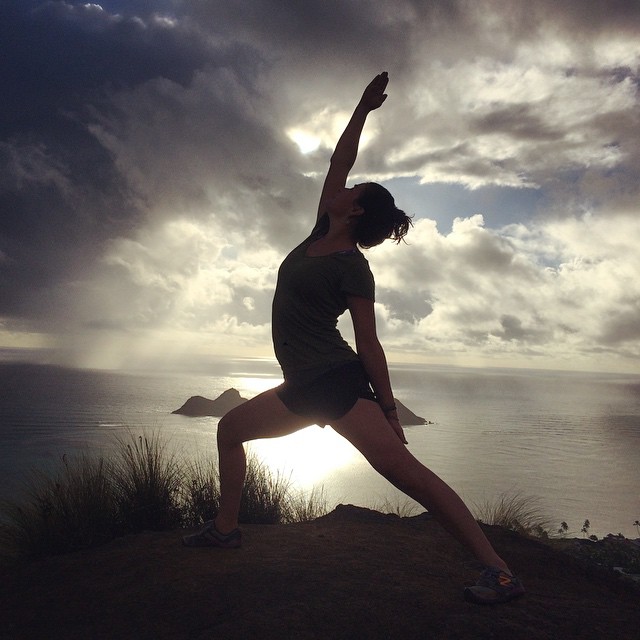

I’m looking at “before and after” images of ten postures and writing a reflection on:
- imagery comparison
- experience of the process
- how to cultivate more of the subtle energetic qualities in my practice
From my instructors:
While this project is simple, it is crucial in your development as a practitioner and teacher to recognize and feel the subtle qualities of your energetic body. Doing this, you will learn to balance the Pancha Vayus within your physical practice and embody these qualities in your yoga.
The Pancha Vayus: Five Movements of Prana (pancha=five; vayu=wind) (Prana=life-force) (direction / location / affect)
- apana: downward/ between navel and rectum/ grounding, securing
- udana: upward/ throat, head, limbs/ lifting, stimulating
- samana: inward/ core, navel/ coiling, equalizing
- vyana: outward/ entire body/ expanding, diffusing, radiating
- prana: cyclical/ heart and lungs/ integrating, reinvigorating
Before pictures:


After pictures:


So. To begin…
Comparisons
- (Silly, obvious things): For the first set, I accidentally did downward facing dog instead of upward facing, as well as revolved side angle with anjali mudra.
- There is so much more lift, length, and expansion (udana and vyana vayu) in the later images! I see it in every pose, really, but especially in Tadasana (neck & shoulders), Utkatasana (pelvis, core, heart, shoulders), Vira I (pelvis, core, heart, shoulders), and Ardha Chandrasana (pelvis, core, heart, shoulders, lifted foot):


- I see more grounding (apana vayu). Noticeable especially in the pelvis and back foot during Vira I and Parivrtta:


- Finally, in both Trikonasana and Parivrtta Parsvakonasana, I notice samana vayu at play–it’s an inward drawing energy from the periphany to the core that supports a lengthened side body in Trikonasana and supported twist in Parivrtta.


Experience
TBH: I was impressed with my “before” pictures at the time: for having never attended a workshop or in-depth instruction on these poses, I thought they were pretty good. (Of course, googling the images right before is always helpful…) I didn’t expect that I would improve much on what I already saw.
AND THEN… I did this assignment and really looked closely between the images and now understand why they are called the subtle qualities. It really is subtle and yet makes a world of difference.
Through the training, I notice that while I mentally understand the vayus, what I connect with more, physically speaking, is the bandhas, or body locks, that have an effect on the movement. For example, I can feel the subtle movements in mula banda and uddiyana bandha that create the lock more than I have been able to connect with or experience the resulting shift in prana.
Moving Forward
In order to cultivate more of the subtle energy in my practice, I’m going to need to do an obvious thing and simply turn my mind more onto its existence: reading on it, reflecting on it, commuting it to memory, seeking to understand more about it. It’s been easy to let these qualities sort of take a lower priority, so to speak, when I’m just trying to make it to practice on time.
I mean, the source of prana is the flow of breath and sometimes it’s all I can do to actually just breathe in the first place.
I believe in the expression “The grass is always greener where you water it,” which means that almost anything can be achieved–even experiencing the subtle effects of pancha vayu–if this is where you make the effort to turn your attention.


Great improvement!
LikeLiked by 1 person